AI Solar Tracking: When Backtracking Improves Real Yield
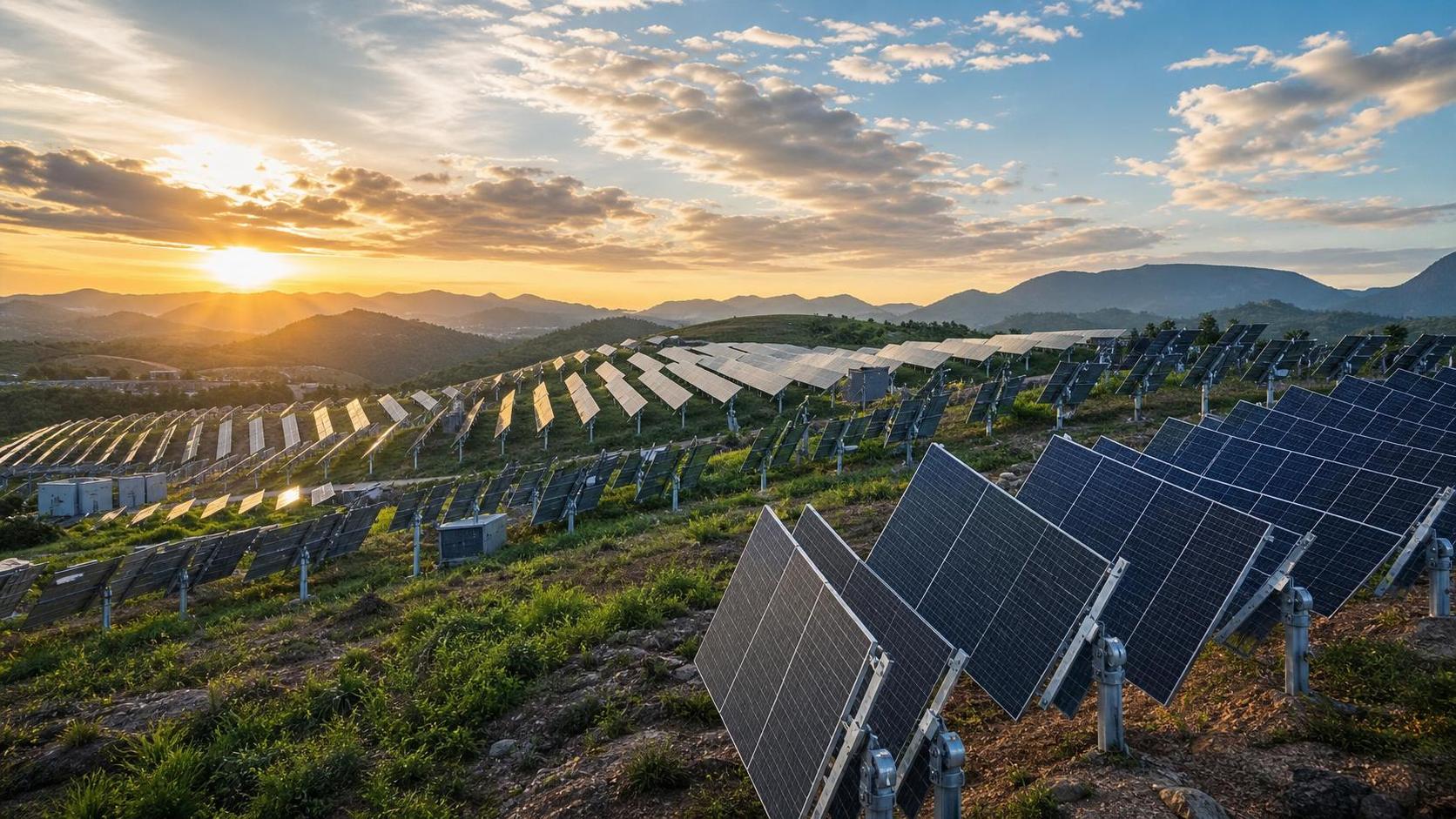
AI Solar Tracking Becomes Valuable When the Site Is Not Ideal
AI solar tracking matters most when real projects drift away from textbook layouts.
Flat land, wide row spacing, and stable irradiance are still the exception in many utility-scale developments.
More common conditions include uneven terrain, constrained footprints, dust, cloud variability, and grid dispatch pressure.
In those cases, backtracking is not a minor control feature.
It becomes part of a yield strategy that protects production otherwise lost to row-to-row shading and unstable operating decisions.
That is why AI solar tracking now sits inside a broader renewable systems discussion.
For REGS, tracker performance cannot be separated from module behavior, inverter response, structural resilience, and grid-value output.
Why the Same Tracker Logic Does Not Fit Every Solar Plant
The main reason is simple: the loss pattern changes from site to site.
A desert project may fight soiling, thermal derating, and wide diurnal swings.
A rolling inland site may struggle more with cross-axis slope and morning shading.
A grid-sensitive plant may also care less about peak noon energy and more about smoother, dispatch-friendly delivery.
In practical terms, AI solar tracking should be judged by how it adjusts tracking angles, backtracking timing, and stow behavior against those losses.
The better systems use astronomical position, irradiance forecasts, terrain data, and operating history together.
That is a stronger standard than quoting a generic gain percentage.
Where Intelligent Backtracking Usually Changes the Outcome
Tight Land Use and High DC Density
Projects with compressed row spacing often chase lower land cost and higher installed density.
The tradeoff is early and late hour shading, which can erase expected tracker gains.
Here, AI solar tracking with intelligent backtracking should minimize shading without giving away too much irradiance capture.
The key judgment is not maximum angle movement, but the best net energy across the full day.
Complex Terrain and Uneven Row Geometry
On sloped or irregular sites, standard backtracking assumptions break quickly.
One section of the array may receive clear sun while another is already self-shaded.
This is where AI solar tracking earns its place.
It can segment tracker behavior by terrain condition instead of applying one plant-wide rule.
That usually improves actual yield more than a mechanically precise but uniform approach.
Volatile Weather and Mixed Irradiance
Cloud transitions complicate the old assumption that direct beam capture always dominates.
Under mixed diffuse conditions, aggressive tracking can produce less benefit than expected.
A better AI solar tracking strategy weighs weather patterns and avoids over-correcting for short-lived irradiance shifts.
That stabilizes performance and reduces unnecessary actuator duty.
Different Conditions Change the Decision Criteria
In actual project reviews, the right question is usually which loss mechanism dominates first.
This wider view reflects the REGS approach.
Tracker intelligence only becomes bankable when it works with PV modules, inverters, structures, and LCOE assumptions together.
What Gets Misjudged Before Deployment
A frequent mistake is treating AI solar tracking as a universal 15% to 20% gain.
That range can be realistic, but only under matching site geometry and operating conditions.
Another weak assumption is evaluating backtracking without checking inverter clipping, curtailment windows, or module mismatch.
There is also a structural blind spot.
More dynamic control is only useful when the mechanical system tolerates wind events, actuator cycling, and long maintenance intervals.
- Do not compare tracker algorithms without the same terrain and row-spacing inputs.
- Do not separate yield gains from cleaning frequency and thermal derating assumptions.
- Do not ignore grid-forming or curtailment behavior in inverter-heavy plants.
- Do not use procurement cost alone as the selection filter.
A Practical Way to Assess Fit Before the Final Design
Start with a site-specific loss map rather than a brochure claim.
Rank shading, terrain, weather variability, stow requirements, and grid constraints by energy impact.
Then test whether AI solar tracking changes the dominant loss, not just the headline production estimate.
The most reliable path is to review tracker logic together with module technology, inverter behavior, and structural design life.
That is where intelligent backtracking stops being a feature list and becomes a real yield tool.
For the next step, define the site conditions clearly, compare scenario-based backtracking models, and check whether the predicted gain survives LCOE, maintenance, and grid-value testing.
Recommended News
Industry Briefing
Get the top 5 industry headlines delivered to your inbox every morning.