
EU CBAM Expansion Reaches Solar and Wind Components

On July 1, 2026, the EU’s Carbon Border Adjustment Mechanism (CBAM) formally expands into additional renewable energy equipment categories, following the European Commission’s amendment issued on June 25, 2026 under EU No 2026/1489. The change brings solar modules, N-type PV modules, Monopiles & Jackets, carbon-fiber wind turbine blades and other listed components into a stricter trade and compliance framework, with direct implications for exporters, buyers, manufacturers, certification-related service providers and supply-chain operators. For companies active in EU-bound solar and wind equipment business, this is not only a policy update but an immediate change in carbon reporting, certificate preparation, pricing logic and delivery planning.
What the amendment clearly changes from July 1
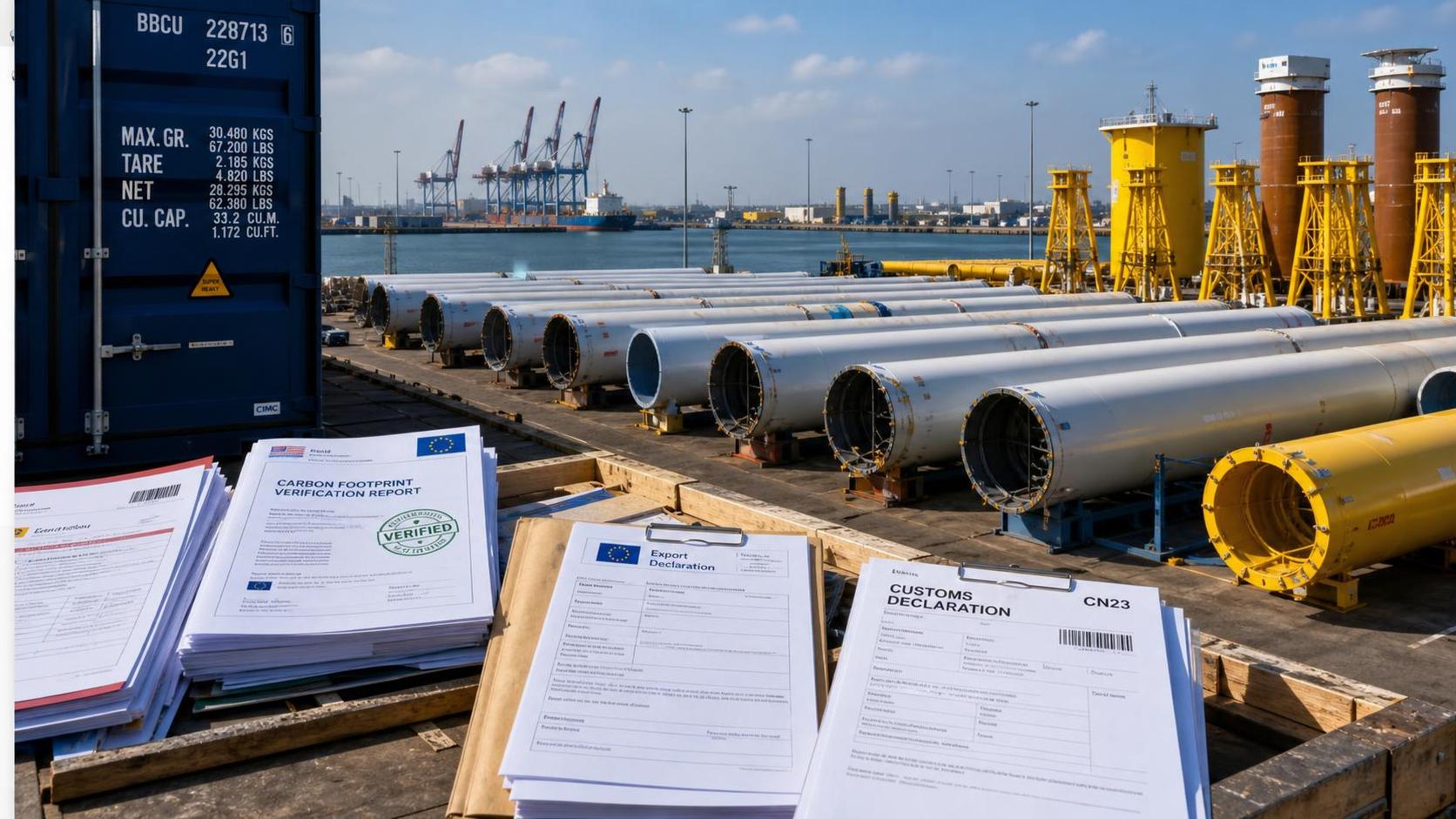
According to the provided information, the European Commission released an official amendment on June 25, 2026, identified as EU No 2026/1489. The amendment officially extends CBAM coverage from July 1, 2026 to 12 categories of key renewable energy equipment components, including photovoltaic modules, N-type PV modules, Monopiles & Jackets, and carbon-fiber wind turbine blades.
The same information states that exporters are required to submit full life-cycle carbon footprint reports certified by an EU-recognized third-party body. It also states that exporters must pre-purchase CBAM certificates.
The provided summary further notes that China accounts for more than 38% of solar and wind equipment exports to Europe, and that the adjustment will directly affect quotation structures, delivery timelines and compliance entry requirements.
Where the immediate pressure is likely to appear
Export transactions now face a higher documentation threshold
From an industry perspective, exporters shipping covered solar and wind components to the EU are likely to feel the earliest impact because the rule change links market access more directly to carbon documentation and certificate preparation. The practical effect is not limited to customs-facing paperwork; it can also affect contract review, quotation validity, shipment scheduling and handover readiness where buyers require proof of compliance before dispatch or acceptance.
Manufacturing and sourcing teams may need earlier data alignment
Analysis shows that manufacturers and procurement teams may need to pay closer attention to the availability and consistency of life-cycle carbon footprint data. Because the new requirement refers to third-party certified full life-cycle reporting, the compliance burden may extend upstream into material sourcing, production record collection and internal document control. Even where execution details are not provided in the input, companies should expect greater scrutiny over whether technical files and supporting records are ready in time for export transactions.
EU buyers and project-side procurement may reassess delivery conditions
For buyers, distributors and project procurement teams, the rule expansion may influence supplier screening and delivery acceptance conditions. What deserves closer attention is that a product category can remain commercially relevant while becoming procedurally harder to place if carbon reporting and CBAM certificate preparation are not synchronized with order and shipment milestones. In practice, this may affect bid evaluation, supplier qualification review and timing expectations for cross-border deliveries.
Certification and testing-related services become more operationally relevant
Observably, the requirement for certification by an EU-recognized third-party body makes verification capacity and document readiness more operationally important. For certification-related firms and testing service providers, the issue is not simply increased attention to sustainability claims, but the fact that certification output becomes tied to transaction readiness and compliance admissibility for covered products.
What companies should review right now
Check whether product scope matches the amended categories
Companies should first review whether their EU-bound products fall within the newly covered component groups referenced in the provided information. This is especially relevant for businesses dealing in photovoltaic modules, N-type PV modules, Monopiles & Jackets and carbon-fiber wind turbine blades, as the compliance starting point is whether a shipment sits inside the amended CBAM scope from July 1, 2026.
Reassess carbon reporting and third-party certification readiness
Analysis shows that one of the most immediate practical questions is whether full life-cycle carbon footprint reporting can be prepared in a form accepted under the new rule. Since the summary only confirms the requirement for certification by an EU-recognized third-party body, but does not provide detailed operational criteria, companies should focus on document completeness, internal traceability and the timing needed to obtain compliant certification output.
Revisit quotations, contract terms and shipment schedules
The provided information expressly indicates that quotation structures and delivery cycles will be affected. It is therefore reasonable for exporters and buyers to review whether current offers, delivery commitments and procurement schedules still reflect the added cost and timing implications of certificate pre-purchase and carbon-footprint verification. This is more appropriately understood as a contract execution and trade planning issue, not only a regulatory filing issue.
Watch for changes in tender files and supplier qualification requests
Where products are sold into project procurement or formal bidding channels, companies should pay attention to whether tender documents, technical submissions or supplier qualification materials begin to reflect the expanded CBAM scope. The input does not provide confirmed downstream implementation language, so this remains an area to monitor rather than a completed market outcome.
Why this looks like an execution signal, not just a policy headline
Observably, this update is better understood as an implemented rule change with immediate trade consequences rather than a distant policy direction. The effective date is explicitly set at July 1, 2026, and the provided summary identifies concrete obligations tied to carbon footprint certification and CBAM certificate pre-purchase.
At the same time, analysis shows that the market still needs to watch how execution language develops in official guidance, certification practice, buyer requirements and transaction documentation. In other words, the rule change itself is already clear in principle, while parts of its operational interpretation may still require continued verification through real-world implementation.
How the market may best interpret the update
For the renewable equipment trade, this development is most usefully read as a higher compliance threshold entering force at the border between policy and transaction execution. It does not automatically determine commercial outcomes for every exporter or supplier, but it does make carbon documentation, recognized certification and certificate-related cost planning more central to EU market access for the covered product groups.
A neutral reading is that the amendment creates an immediate compliance signal and a near-term operational adjustment point. The closer question for the industry is no longer whether the CBAM framework is moving into these product categories, but how quickly companies can align documentation, pricing and delivery processes with the new requirement set.
Basis of this article and what still needs verification
This article is generated from the user-provided news title, event date and event summary. The analysis is based only on the provided information concerning the July 1, 2026 CBAM scope expansion, the June 25, 2026 amendment identified as EU No 2026/1489, the listed covered product groups, the requirement for EU-recognized third-party certified full life-cycle carbon footprint reports, the pre-purchase of CBAM certificates, and the stated export share above 38%.
For events of this type, relevant source categories typically include official regulatory announcements, publications by competent authorities, customs or trade administration updates, industry association notices, standard-setting documents and reporting by established professional media. No specific official source link was provided in the input, so the exact official publication path still requires ongoing verification.
What still needs continued observation includes detailed implementation language, certification application practice, document acceptance standards, changes in tender requirements, industry feedback and how affected companies execute the new requirements in actual trade and delivery processes.
Recommended News


Industry Briefing
Get the top 5 industry headlines delivered to your inbox every morning.