
EU CBAM Extends to Offshore Wind Foundations
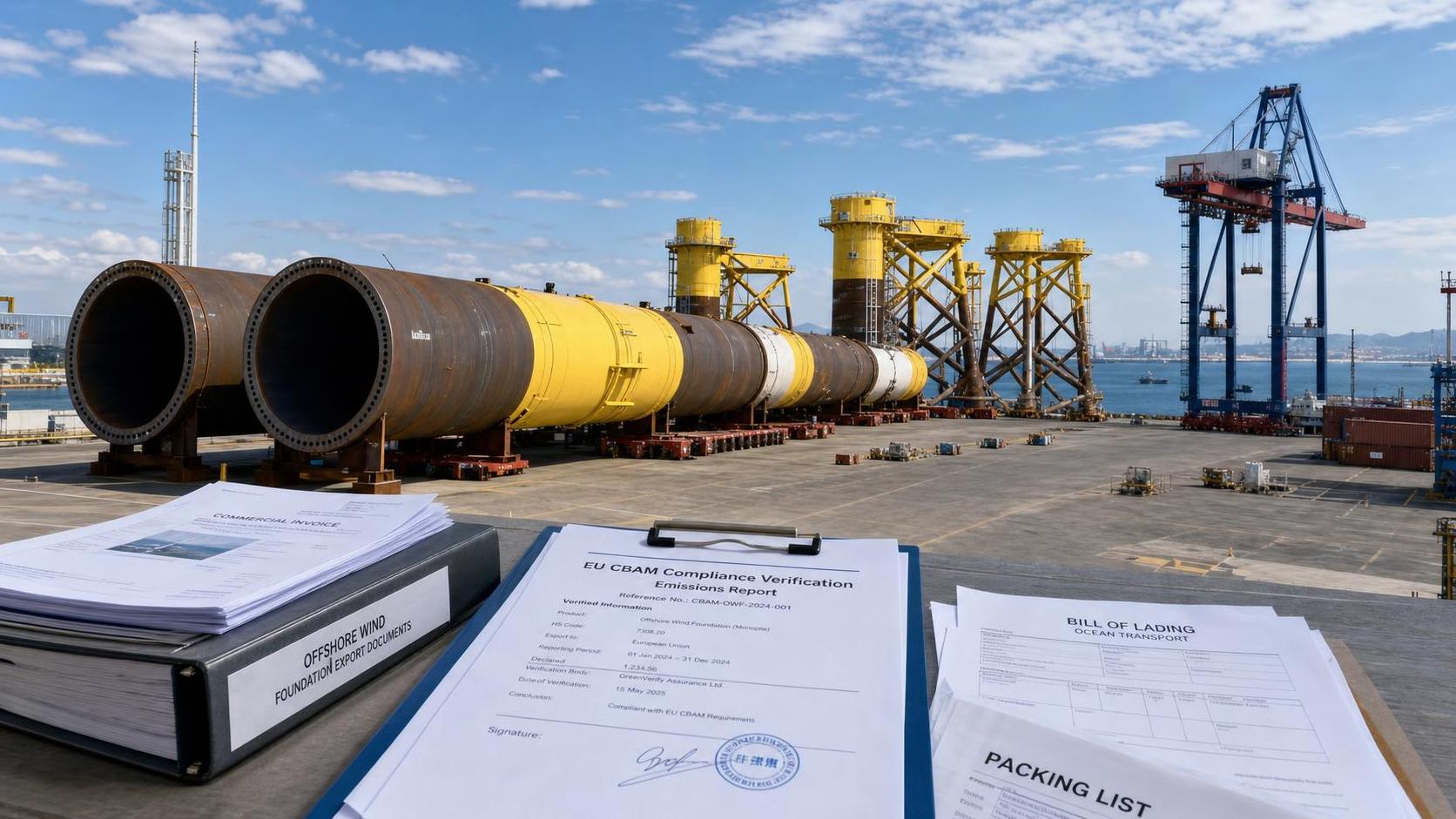
On August 1, 2026, a new compliance threshold takes effect for offshore wind foundation products entering the EU market: monopiles and jackets are now brought within the scope of CBAM carbon accounting requirements. Based on the revision released by the European Commission on July 20, 2026, the change matters not only for exporters of these structures, but also for procurement teams, verification providers, contract managers, and delivery planners, because carbon-footprint documentation is no longer peripheral paperwork and instead becomes part of market access and transaction execution.
What the Revision Formally Changes
The confirmed change is that the European Commission published a revised CBAM implementing measure on July 20, 2026, explicitly adding monopiles and jackets to the mechanism's coverage. The rule applies to such foundation structure products imported and declared from August 1, 2026 onward. The event summary further states that this directly affects the compliance path for major Chinese offshore equipment manufacturers exporting to Europe, and that suppliers are required to provide life-cycle carbon footprint reports verified by a recognized third party, with those requirements embedded into procurement contract terms.
Where the Immediate Pressure Will Appear
Export transactions now depend on carbon documentation
From an industry perspective, exporters of monopiles and jackets are likely to face the most direct impact because the rule is tied to imported products from the customs declaration stage onward. The practical effect is that shipment readiness may no longer depend only on product completion and trade documents, but also on whether the required carbon-footprint materials are available in the form expected by the buyer and compliance process.
Procurement teams will need to translate compliance into contract language
Purchasers and sourcing teams are also likely to be affected because the event summary makes clear that verified life-cycle carbon footprint reporting must be embedded into procurement contracts. That shifts carbon reporting from a technical appendix into a contractual condition. What deserves closer attention is whether procurement documentation, supplier qualification terms, and acceptance conditions are updated in time for orders linked to post-August 1 import declarations.
Verification and supporting service providers may become part of delivery critical path
Certification-related and testing-related service participants may see a more operational role, since the requirement refers to third-party verified life-cycle carbon footprint reports. Analysis shows that where reporting is mandatory, the availability, timing, and acceptance of verification outputs can influence whether commercial and delivery commitments proceed smoothly, even if the product itself is already manufactured.
Operational Points Companies Should Watch Closely
Check whether existing files can support verified carbon reporting
Analysis shows that companies involved in offshore wind foundation exports should first review whether current technical, production, and traceability records can support a life-cycle carbon footprint report that is verified by a recognized third party. The input does not provide detailed execution criteria, so this should be treated as a practical review point rather than an assumption that current files will be sufficient.
Review procurement clauses before new orders move forward
Because the summary expressly mentions procurement contract terms, companies should pay attention to whether new tenders, purchase orders, framework agreements, and supplier appendices begin to incorporate carbon-reporting obligations, document submission timing, and verification responsibility. At this stage, it is more appropriate to understand this as a contract and compliance coordination issue, not only a reporting issue.
Watch the link between declaration timing and delivery scheduling
Observably, the rule is anchored to products imported from August 1, 2026, which means trade and logistics teams will need to pay close attention to declaration timing in relation to shipment planning and handover milestones. The input does not provide detailed customs treatment or grace arrangements, so companies should avoid assuming that pre-existing delivery plans are unaffected.
Follow how buyers and market documents begin to reflect the change
What deserves closer attention is how this requirement starts appearing in buyer specifications, tender documents, supplier onboarding checks, and document request lists. Since the confirmed facts stop at the rule expansion and reporting requirement, any broader market practice still needs to be monitored rather than treated as settled.
Why This Reads as More Than a Policy Signal
In analytical terms, this development is better understood as an execution-stage compliance change rather than a distant policy indication, because the summary includes a clear effective import date and a concrete documentation expectation tied to third-party verification and contract clauses. At the same time, it should not yet be overstated as a fully transparent operating framework, since the input does not provide the full downstream interpretation that buyers, verification bodies, and trade operators may apply in practice.
How the Industry Should Read It Now
The more balanced conclusion is that this update marks a rule change with immediate relevance for offshore wind foundation exports into the EU market, especially where commercial delivery depends on accepted carbon accounting records. It is more appropriate to understand the event as a landed compliance requirement with further execution details still worth watching, rather than as a general policy discussion or a completed market transition.
Basis of This Article and What Still Needs Verification
This article is generated from the user-provided news title, event date, and event summary. For developments of this kind, relevant source categories would typically include official notices, regulator publications, customs or trade authority updates, industry association information, standards-related documents, and reporting by established trade or industry media. A specific official source link was not provided in the input, so that point still requires verification. Further observation is also needed on implementing detail, verification interpretation, tender document changes, market feedback, and how companies ultimately execute the requirement in practice.
Recommended News

Industry Briefing
Get the top 5 industry headlines delivered to your inbox every morning.